Showing posts with label Interpretations. Show all posts

Sunday, 19 February 2012

Two great men: Churchill and Gandhi


If you were holding a dinner party for historical figures, who would you invite?

*Pause for thought*

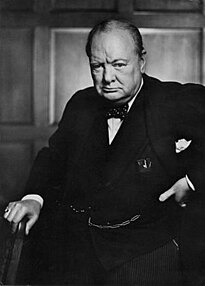
Churchill and Gandhi are quite likely to feature in this imaginary feast and both personalities were great men in their own right. In fact, I admire them both and you might be hard pressed to find someone who didn't. In India, Gandhi's face is still all over their money (ironic given his own poverty and humility) and Churchill is still considered to be the classic representation of British greatness.

However, it can be difficult to get away from these accepted versions of people's personalities. Whilst studying Gandhi at university it felt odd to accept many of his shortcomings as leader and a man (perhaps I'll make it the topic of a future blog post). In the same way, my sixth formers are finding it difficult to get away from their interpretation of Churchill as one of the greatest Britain's who ever lived. Most want to keep their rose-tinted view of him despite my efforts to convince them that at times he was a complete plonker.

This became an easier task when comparing him with Gandhi. Despite both being in some ways great men, if you invited Churchill and Gandhi to your dinner party, they would not get on.

Gandhi is best known for his impassioned appeals for the independence of India from British Imperial rule. He dismissed the use of violence and was willing to take non-violent protest to the extreme. He fasted on a number of occasions to near starvation to try to stop conflicts.

Tuesday, 14 February 2012

The controversial Creation of Israel

The land of Israel/Palestine has been fiercely disputed throughout the last 3,000 years. Through the Roman occupation, Crusades and the most recently the Arab-Israeli conflict, this small strip of land has a continuous history of conquest, war and bloodshed.

When I talk to friends about teaching this, their knowledge is often good and they have heard a lot about the problem. But, many also say that they don't know enough about it to have a full viewpoint on the issues.

It's difficult to fully understand all of these issues but there are many aspects to find fascinating (and deeply distressing) about the study of this area but the deep feelings expressed by either side are perhaps some of the most hard-hitting.

This was recited by Palestinian school children at the beginning of their school day:

Palestine is our country

Our aim is to return
Death does not frighten us
Palestine is ours
We shall never forget her
Another homeland we shall never accept.


The second is one (probably very popular) Jewish view from the 1940s:
There is no room for both peoples in this country. If the Arabs leave the country, it will be broad and wide-open for us. If the Arabs stay, the country will remain narrow and miserable. The only solution is Israel without Arabs.

The question is: How did the two sides end up so divided and will there ever be a solution?

Thursday, 22 December 2011

The two sides of Napoleon Bonaparte

Napoleon had two sides. It's possible to see him as a megalomaniac dictator whose arrogance and self-promoting egotism led to nearly 15 years of continual war and the deaths of millions of Europeans. From his rise to power in 1799 to his first abdication in 1814 he went to war with Britain, Austria, Prussia, Russia, the Ottoman empire, Spain, Portugal... need I go on? He won and lost a huge empire, repressed the rights millions and took apart the democracy and liberty of the French Revolution.